



 Facebook
 Reddit
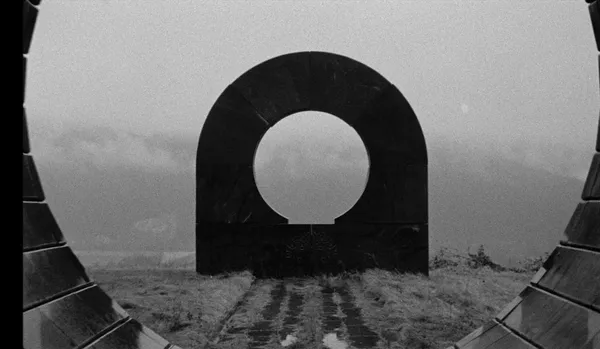
One of the most important contributions that science fiction has made to the broader genre of speculative and philosophical literature, Olaf Stapledon's 1930 novel has long been considered unfilmable. Its epic scope, charting a future history of humanity across two billion years and many different biological iterations, proved too much for even the boldest directors to take on, whilst the intimacy of its central story - communications sent by a member of a dying race to today's Earth - was difficult to dramatise. By eschewing the epic in favour of a pared down, black and white minimalist approach, Iceland's Jóhann Jóhannsson has created something that successfully captures the spirit of the book whilst feeling like a memorial to humanity.
Jóhannsson is best known as a composer and the score that echoes through Last And First Men carries much of the weight of its narrative. Combined with slowly shifting images of stone monuments, it hypnotises the viewer and establishes a connection with deep time that is vital to appreciating Stapledon's ideas. Perhaps the director's own origins help with this - Iceland is unusual in having a language which has changed so little over the centuries that it's still easy for the average person to read stories written by its first settlers, to understand the inscriptions they left behind, so that a sense of history is vital within the island's culture. There may also be something here of the folklore of the Balkans, where the film was shot, where memorial sculptures erected after the war reside among ancient megaliths whose origins remain unknown. Obscurely carved, they stretch up towards the sky, the relics of those who lived before us peering into the future.
 Also critical here is the voice of Tilda Swinton, speaking for that unknowable contact from the far future. It's difficult to think of any actor who could be better suited to this role; it is not only as Virginia Woolf's Orlando that Swinton has seemed adrift in time, fluid in form. Here her presence is signalled intermittently by a blinking green light which sometimes becomes a streak, like a signal picked up by a radio telescope from the remotest depths of space. The film is textured, scratched in places, giving it the look of something once lost and now painstakingly restored. Jóhannsson's footage comes in from curious angles as if captured by someone unfamiliar with the shapes on display, unused to the way that our bodies move in the world and our eyes reveal it. Its strangeness is compelling.
It's hard to stress enough that this is not a film for everyone. Some viewers will not get into the spirit of it at all. To do so, one must be willing to listen and to open oneself up to possibility. Swinton's voice, though it rarely expresses much emotion, softly commands attention. It is vital that we listen. There isn't much time.
Perhaps Last And First Men has come of age. It is easier, now, for the average person to understand that urgency. A lot has happened in 90 years and Stapledon's vision of a species (or series of species) lurching from crisis to crisis has never seemed more pertinent. Finding a natural home at the Edinburgh International Film Festival, Jóhannsson's adaptation is full of sorrow and longing and, still, the hope of what we might become.
Reviewed on: 03 Jul 2020

If you like this, try:
Review preview for 2001: A Space Odyssey
The long wordless opening of 2001 remains one of the most beautiful sequences on film.
Review preview for Into Eternity
This is a powerfully atmospheric film that goes beyond the conventional techniques of documentary to communicate concepts we might otherwise struggle to grasp.
Review preview for Nostalgia For The Light
Patricio Guzmán has wisely chosen to step back and let the story unfold largely by itself.